



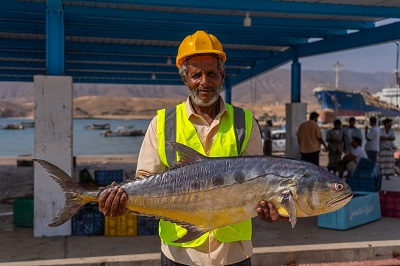
Protecting Livelihoods Along the Shores of Al-Mahrah – The Story of a Fisherman from Nishtoon
At dawn, along the rugged coastline of Nishtoon in Yemen’s eastern Al-Mahrah governorate, fishing boats begin to appear on the horizon, returning from long nights spent at sea. Among them is Omar Sa‘deen, a fisherman who has spent most of his life navigating the waves, drawing from the sea the livelihood of his family and community.
Omar says:
“Sometimes I leave home for the sea and stay there overnight. I practice all kinds of fishing, whether with nets or swords.”
For many years, Omar and his neighbours endured a harsh reality—an unpredictable sea, a struggling economy, and fragile infrastructure that offered little support. Recalling those days, he says:
“At home, we suffered from shortages in everything. Work was scarce, food was scarce, and everything was difficult. Those were very hard times, and even today, life remains full of challenges.”
One of the greatest obstacles faced by fishermen in Nishtoon was the absence of a suitable place to handle and store their catch after returning from the sea. Without shelter to protect fish from the scorching sun, fishermen were forced to sell their catch quickly at low prices or risk spoilage.
Omar explains:
“In the past, there was a cold storage facility, but it was exposed and not functioning properly. Our attempts to store fish were limited. Today, things are much better than they used to be.”
Thanks to the fish landing site rehabilitation project, implemented with the support of the King Salman Humanitarian Aid and Relief Center in partnership with the World Food Programme, hundreds of fishermen now finally have access to shaded areas where they can clean their catch, place it in refrigerated storage units, and sell fish in safer, healthier, and more organized conditions.
The new facility has also enabled fishermen to store their catch for longer periods without spoilage, reducing waste and strengthening their bargaining power in local markets. For many families, this translates into greater stability at a time when Yemen’s coastal communities continue to face rising living costs, shrinking job opportunities, and increasingly severe storms.
Omar concludes:
“Overall, the project has significantly improved our working conditions and helped us manage fishing and storage more efficiently.”