

Dr. Al Rabeeah: "The Kingdom Has Developed Humanitarian Work Based on Sound Principles and Established Humanitarian Norms"
Author: KSrelief
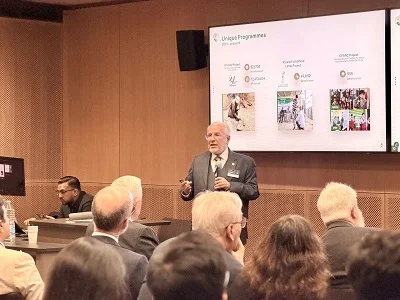
His Excellency Dr. Abdullah Al Rabeeah, advisor to the Royal Court and general supervisor of the King Salman Humanitarian Aid and Relief Centre (KSrelief), affirmed that the Kingdom has always been a pioneer in the field of humanitarian work, leading Arab nations and ranking among the first globally. He noted that Saudi charitable field teams have traveled the world to serve those in need, alleviating the suffering of the less fortunate and bringing smiles to the faces of both the elderly and children.
This was stated during his lecture titled "Humanity in Medicine," held yesterday at the Zayed Center for Research at Great Ormond Street Hospital in London, attended by pediatric surgeons and trainees in pediatric surgery and pediatric doctors.
Dr. Al Rabeeah explained that since its founding by King Abdulaziz bin Abdulrahman Al Saud—may God have mercy on him—the Kingdom has been committed to supporting and developing humanitarian and relief work on solid foundations and established norms, recognizing the importance of this work in alleviating human suffering and addressing the urgent needs of populations experiencing humanitarian crises and natural disasters worldwide. Since 1975, the Kingdom has launched 8,406 humanitarian, relief, and development projects valued at over $142 billion, covering 173 countries worldwide.
He noted that, thanks to God's grace and the instructions and interest of the Custodian of the Two Holy Mosques, as well as the careful follow-up by His Royal Highness the Crown Prince, humanitarian work in the Kingdom has gained a global dimension. Since its establishment, the center has executed 3,881 projects across various vital sectors, such as health, food security, education, and water and environmental sanitation, impacting 109 countries with a total value exceeding $8.251 billion.
He highlighted that, wishing to showcase the Kingdom's efforts internationally similar to major donor countries, several platforms for relief, volunteering, documentation, and international registration have been established, such as the Saudi Aid Platform, the platform for assistance provided to refugees in the Kingdom, the Saudi portal for external volunteering, and the electronic donation platform "Saham."
Dr. Al Rabeeah added that KSrelief has initiated several specialized programs to assist those in need, including KSrelief's "Masam" project to clear Yemeni lands of mines, prosthetic centers, and the reintegration project for children formerly associated with armed conflict, named "Kifak."
He also spoke about the Saudi Conjoined Twins Programme, which has successfully performed 67 separation surgeries since its establishment in 1990 and has assessed 152 cases from 28 countries, providing a brief explanation of the causes of conjoined twins and showcasing some cases under review and those that have been separated, along with the advanced techniques used in treating these cases.
He recalled the signing of a financial contribution agreement of $100 million with the Islamic Development Bank to support the Livelihoods Fund of the Islamic Development Bank Group in 2025, which will benefit nearly 200 million individuals from 37 countries, most of which are in the Sahara region of Africa and Asia.
At the conclusion of the lecture, Dr. Al Rabeeah emphasized the importance of enhancing the strategic partnership between the center and Great Ormond Street Hospital to serve marginalized populations. He called for stronger connections between humanitarian work, development, and peace to support affected communities worldwide, highlighting the need for new funding sources for humanitarian work in partnership with the private sector and emphasizing the quality investment opportunities it provides. He pointed out the importance of mutual international cooperation to raise awareness and education about conjoined twins and to reintegrate them into society while preserving their rights and human dignity, urging adherence to international humanitarian law principles in all charitable activities.
At the end of the lecture, attendees watched a video presentation in honor of International Conjoined Twins Day, observed on November 24 each year, which was well received.